How Does Master Flame Work on Wood and Lumber?

Wood is one of the most versatile building materials in the world, and one of the most combustible. Whether you're framing a new home, finishing a garage, building a deck, or working on a smaller DIY project, untreated wood is a liability in a fire event. Master Flame changes that.

Unfinished Wood Only
Before anything else, this is the most important thing to understand about applying Master Flame to wood: it must be applied to bare, unfinished surfaces. Master Flame works by penetrating deep into the wood grain, and if the surface has already been painted, stained, sealed, or coated in any way, that barrier will prevent absorption, and the treatment will not be effective. If you're working with raw lumber, freshly milled wood, or any unfinished surface, you're ready to go. If the wood has an existing finish, sand it down to bare wood first. Once the surface is open and absorbent, Master Flame can do its job.
How It Works
Like all Master Flame applications, the formula absorbs directly into the material rather than sitting on its surface. Once it penetrates the wood grain, it binds within the cellular structure of the lumber, forming a protective barrier that resists ignition and dramatically slows the spread of flames. The result is wood that is significantly harder to catch fire and, when exposed to a flame source, far less likely to contribute to the spread of a fire event.
Application at Any Scale
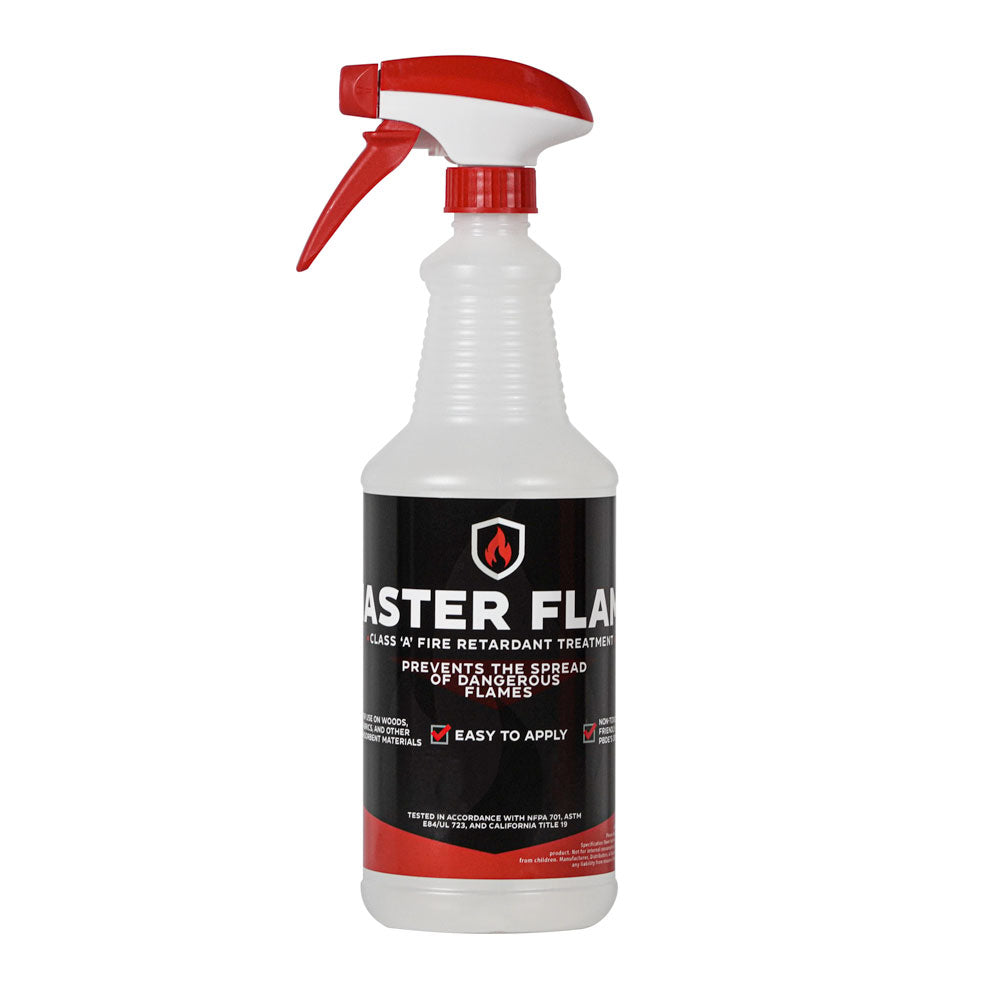
One of the biggest advantages of Master Flame is how straightforward its application process is. There's no special equipment, no certified installer, and no complicated process required. If you can use a spray bottle, you can apply Master Flame. For smaller projects - a single piece of trim, a decorative wood element, or a custom build - a quart bottle with a spray attachment is all you need. For mid-sized applications, lumber can be soaked directly in Master Flame to ensure deep, thorough penetration throughout the material. For large-scale construction projects involving significant quantities of lumber, a pump sprayer or commercial spray device makes it practical to treat an entire framing job, a full deck structure, or a building under construction before finishing work begins.

Painting and Staining Over Master Flame
Master Flame must always be applied first. Once treated, allow Master Flame to fully dry for a minimum of 24 hours before applying any topcoat; this gives the formula time to fully absorb and cure within the wood before anything is layered on top. After that window, Master Flame is compatible with water-based paints and stains and can be finished as normal.
For outdoor applications such as decks, exterior framing, pergolas, fences, or any wood exposed to the elements, applying a paint or stain after treatment is not just an option, it's a necessity. Master Flame is water-soluble, which means prolonged exposure to rain, snow, or moisture will gradually wash away its protective properties. A properly applied topcoat seals the treatment in and preserves its effectiveness over time, giving you the best of both worlds: weather resistance on the outside, fire resistance locked into the wood beneath.

Where It Can Be Used
As long as the wood is unfinished and absorbent, Master Flame can protect it. That covers an enormous range of residential and commercial construction applications like wall framing and structural studs, floor and ceiling joists, roof decking and rafters, subfloors, sheathing, garage framing, deck boards and support structures, fences, sheds, pergolas, and more. If it's raw wood that hasn't been finished, Master Flame can make it dramatically safer.
Tested to ASTM E84 Standards
Master Flame has been independently tested and certified to ASTM E84; the definitive standard for evaluating the surface burning characteristics of building materials. Referenced by the International Building Code, NFPA 101, and NFPA 5000, ASTM E84 is the benchmark used by architects, builders, fire marshals, and code authorities nationwide to determine how a material behaves in a fire.
The test itself is rigorous. Known as the "tunnel test," it's performed in a 25-foot enclosed chamber where a 24-foot specimen is mounted horizontally in a ceiling configuration and exposed to a sustained 88 kilowatt flame insult for ten minutes. Throughout the test, two critical values are measured and reported as an index: how far and how fast the flame travels across the surface of the material, and how much smoke the material produces. The results are then assigned one of three classifications; Class A (the highest), Class B, or Class C, based on where the material lands on those scales.
To achieve a Class A rating, a material must score 25 or below on the Flame Spread Index and 450 or below on the Smoke Developed Index.
Master Flame, tested on standard construction grade lumber by SGS North America, earned a Class A rating, the highest possible classification. The Flame Spread Index came in at 15, well within Class A range. Smoke Developed came in at 55, a fraction of the 450 maximum. Flame spread was contained to just 5 feet of the 24-foot specimen, ignition didn't occur until 1 minute and 27 seconds into the test, and there were zero unusual observations throughout. That means no drips, no delamination, no sagging, nothing. A single coat of Master Flame on untreated lumber produced a result that met the most stringent tier of fire performance classification recognized by the building code.
The Bottom Line
Whether you're a homeowner protecting a new deck, a contractor treating framing lumber before walls go up, or a builder working through a large commercial project, Master Flame offers tested, certified protection for unfinished wood at any scale. Apply it before the finish goes on, seal it in for outdoor applications, and know that the structure you're building has a meaningful line of defense against fire.